

Diptera.info :: Identification queries :: Diptera (adults)
Who is here? 1 guest(s)
 Two Calliphoridae?
|
|
| lynkos |
Posted on 22-07-2005 17:10
|
|
Member Location: Rome, Italy Posts: 466 Joined: 20.06.05 |
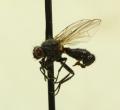
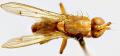
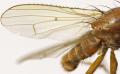
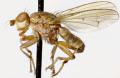
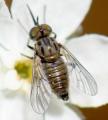
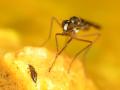
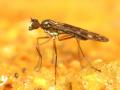
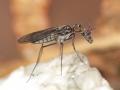
Below are four pictures taken by a friend of mine (again near Rome, Italy). The first two are certainly the same fly, but the second two may be different. Trying to put them at least in a family, I'd say Calliphoridae. Would I be right? And if not, what am I doing wrong!! Thanks in advance, Sarah Photo 1: 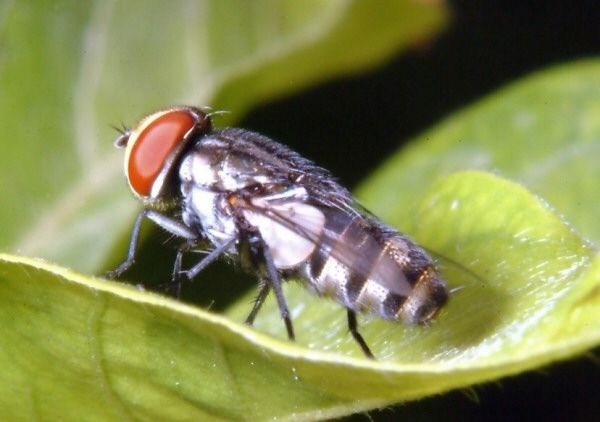 Photo 2: 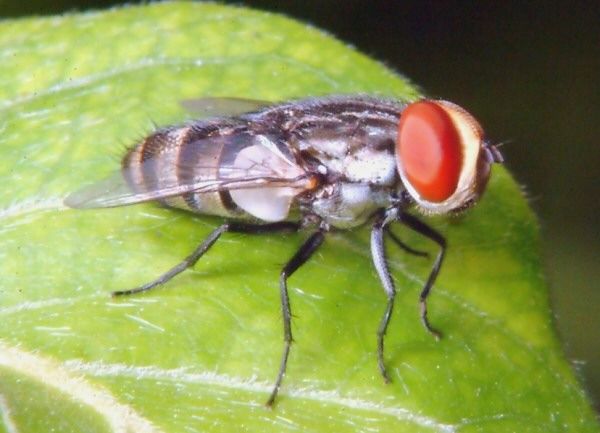 Photo 3: 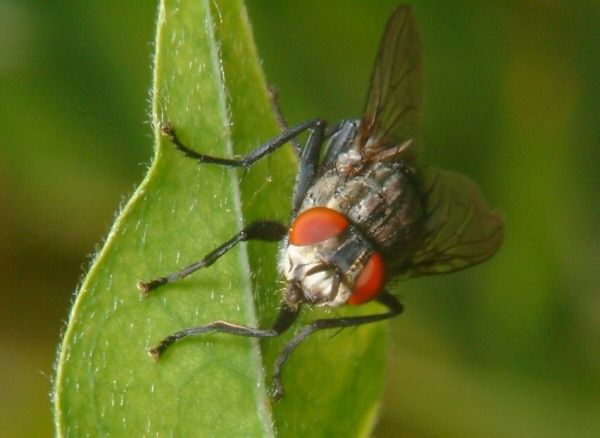 Photo 4: 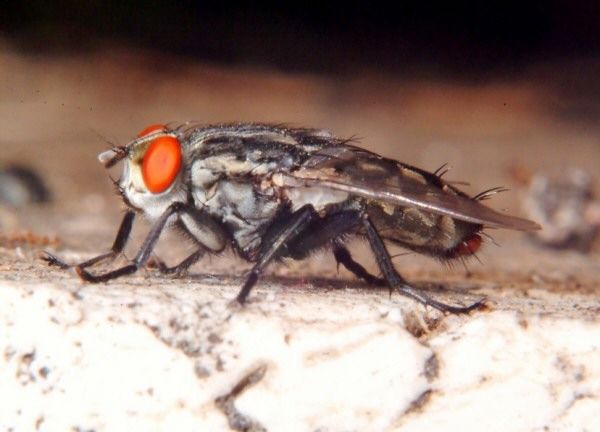 |
 |
|
| Zeegers |
Posted on 22-07-2005 20:40
|
|
Member Location: Soest, NL Posts: 19336 Joined: 21.07.04 |
No Calliphoridae, but Sarcophagidae. Always difficult to tell. The first one is in the subfamily Miltogramminae, genus Miltogramma. It seems that there are large vittae on the thorax, in which case M. taeniata might be an intelligent suggestion. The second one is in Sarcophaginae. It has red genitals, often encountered in for instance Helicophagella. But for me impossible to tell. Theo Zeegers |
|
|
|
| lynkos |
Posted on 23-07-2005 07:32
|
|
Member Location: Rome, Italy Posts: 466 Joined: 20.06.05 |
Thanks Theo. If you have a moment, could you explain what are the salient differences between the Calliphoridae and the Sarcophagidae. It's about time I learnt to find my way around the fascinating world of the Diptera! Sarah |
|
|
|
| Zeegers |
Posted on 23-07-2005 14:41
|
|
Member Location: Soest, NL Posts: 19336 Joined: 21.07.04 |
Hi Sarah, To be honest: no, I can't. Modern textbooks will separate the two families on the relative position of the praesutural and posthumeral bristle on the thorax. this feature is, however, highly artificial. That the matter is delicate, is also illustrated by the fact that only quite recently the genus Eurychaeta = Helicobosca has been transferred from Sarcophagidae to Calliphoridae. However, I can tell you some rule of thumbs: metallic green or blue flies are never Sarcs, but always Callis (or, one of the few Tachinidae!). Species with a grey-and-black checkered abdomen and trafficlight-red eyes (not dark red) are bound to be Sarcs (exception: Eurychaeta, see above, with yellow instead of dark palps). Species with in the wing venation a long appendix or fold to the main bend (in vein R 4+5) are likely to be Sarcs. On the other hand, species with the eyes nearly touching are bound to be male Calliphoridae. Species with conspicuous red genitalia are Sarcophagidae - Sarcophaginae (both male and female).0 To make the situation even more complicated, both families are very diverse themselves. The Sarcophagidae fall into twe groups: Sarcophaginae (your second) and Miltogramminae (your first). (If Jan Velterop is reading this: I'm trying to stick to the main talk and skip some details here and there !). Miltogramminae has only 1 anterodorsal bristle on the tibia 2 and the antennal arista bare (in most cases). Sarcophaginae has more than 1 ad. bristle on tibia 2 and the antennal arista plumose. Enough for now, I hope, I skip the Calliphoridae for the moment. Theo |
|
|
|
| Paul Beuk |
Posted on 23-07-2005 15:13
|
 Super Administrator Location: Netherlands Posts: 19403 Joined: 11.05.04 |
Theo, Can you post the reference for the transferral of Eurychaeta? Thanks, Paul - - - - Paul Beuk on https://diptera.info |
|
|
|
| lynkos |
Posted on 24-07-2005 05:40
|
|
Member Location: Rome, Italy Posts: 466 Joined: 20.06.05 |
Great stuff Theo, a post to copy and keep for future reference. It IS complicated, but then I've already realised that the world of the Diptera is extraordinarily complex and rich. I hope some day to have time to really get down to studying in depth, until then, I'm just thankful you're all here to help me with your endless kindness, patience and knowledge  , Sarah , Sarah |
|
|
|
| Zeegers |
Posted on 25-07-2005 08:23
|
|
Member Location: Soest, NL Posts: 19336 Joined: 21.07.04 |
Eurychaeta has been transferred by Rognes, I believe, you can find the details in Fauna Scandinavica (though that is not the source). The transerve has been acknowledged by Pape, so the leading Calliphoridae and Sarcophagidae experts agree on this matter. Theo |
|
|
|
| Zeegers |
Posted on 25-07-2005 08:24
|
|
Member Location: Soest, NL Posts: 19336 Joined: 21.07.04 |
Hi Sarah, Glad you liked it. Keep on working, and a new master will be born. Theo |
|
|
|
| Jump to Forum: |