

Diptera.info :: Identification queries :: Diptera (adults)
 Efferia or Machimus?
|
|
| Stephen |
Posted on 24-08-2006 22:38
|
 Member Location: West Virginia USA Posts: 1322 Joined: 12.04.05 |
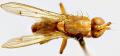
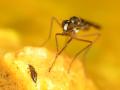
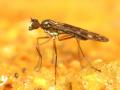
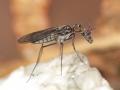
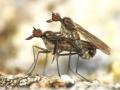
Can someone tell me how to distinguish Efferia from Machimus? When I look at photos of the two genera, they look similar and I can't figure out which characters are used to separate them. This robber was photographed on a gravel driveway, West Virginia, USA, 18 September 2005. Thanks for any help! Stephen attached the following image: 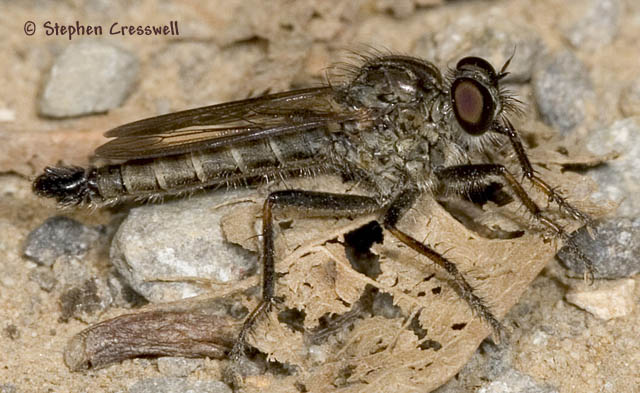 [86.29Kb] --Stephen Stephen Cresswell www.americaninsects.net |
 |
|
| Stephen |
Posted on 24-08-2006 22:40
|
|
Member Location: West Virginia USA Posts: 1322 Joined: 12.04.05 |
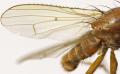
Second image
Stephen attached the following image: 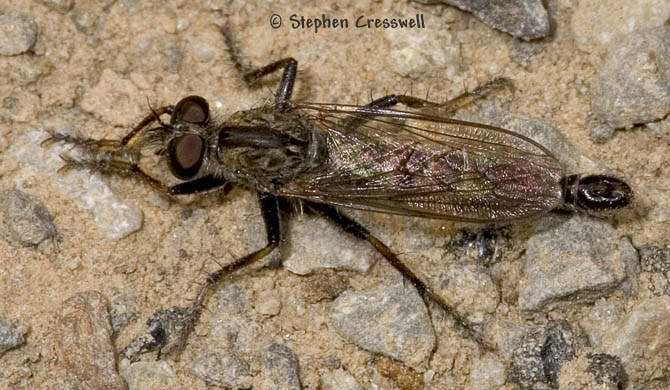 [97.97Kb] --Stephen Stephen Cresswell www.americaninsects.net |
|
|
|
| Tony Irwin |
Posted on 25-08-2006 10:00
|
 Member Location: Norwich, England Posts: 7352 Joined: 19.11.04 |
According to the Manual of Nearctic Diptera, you need to look at the anatergite (a small bump on the metathorax, just above the haltere and below the scutellum). It is pilose in Machimus and related genera, and bare in Efferia and related genera. I suspect this will be difficult to see in photographs! Eric, or another of the North American asilid experts may be able to offer a more practical suggestion. 
Tony ---------- Tony Irwin |
|
|
|
| Stephen |
Posted on 25-08-2006 10:55
|
|
Member Location: West Virginia USA Posts: 1322 Joined: 12.04.05 |
Thanks, Tony, I have been wanting this piece of information for some time. I am glad to know it even though as you say it won't prove much use to photographers. I suspect you're right that I need someone familiar enough with Nearctic robber flies that they can tell at a glance the genus. The good news is that that in the eastern U.S. there are only a relatively small number of species in each genus; in the western states there may be dozens and dozens in each genus. Thanks again for your help! --Stephen Stephen Cresswell www.americaninsects.net |
|
|
|
| Eric Fisher |
Posted on 25-08-2006 15:34
|
 Member Location: California Posts: 435 Joined: 19.05.06 |
Tony is correct in pointing out that the condition of the anatergite (hairy in Machimus & relatives, bare in Efferia etc.) is very important in keying out this group of Asilidae; and that this character can rarely be seen in photographs! But Efferia (although a huge genus with several hundred spp.) has a distinctive 'jizz' which can be used to identify photographed specimens to genus. Male Efferia have their genitalia formed into a large, hammer-shaped cylinder that projects vertically from the axis of the abdomen at nearly a right angle (Machimus males have smaller genitalia that are more in-line with the abdomen - as your photo 1 nicely shows); female Efferia have long, laterally flattened, sword-like ovipositors, which are much longer than preceeding abdominal segments (Machimus females have much shorter ovipositors shaped like a slightly flattened, elongate cone). The shape of the face (both sexes) is very different, with Efferia having the ventral 3/4 abruptly produced into a round hump, and leaving the upper 1/4 (between the hump and antennae) quite flat and vertical; Machimus faces have a low swelling in the ventral 2/3, then a gradual slope to the antennae (also shown nicely in your photo 1). The wing venation is also very different in these genera, but we would need special wing photos to appreciate these characteristics. Eric. |
|
|
|
| Stephen |
Posted on 26-08-2006 13:33
|
|
Member Location: West Virginia USA Posts: 1322 Joined: 12.04.05 |
Eric, Thank-you, this is fantastic. I am going to bookmark this information so I can return to it each time I have a robber that seems to be Efferia or Machimus. Thanks so much for your help!
--Stephen Stephen Cresswell www.americaninsects.net |
|
|
|
| Jump to Forum: |