

Diptera.info :: Identification queries :: Diptera (adults)
 Not the Common Housefly, or is it?
|
|
| gardensafarinl |
Posted on 29-01-2006 18:19
|
 Member Location: Arnhem, the Netherlands Posts: 79 Joined: 09.01.06 |
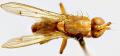
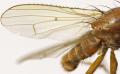
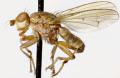
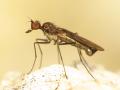
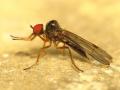
Dear Members, I dug this one up from the archives. Photographed in a garden in Holland, August 22nd. For some time I believed it to be a Common Housefly, which pleases me, as it still isn't on my site. Later I got some doubts. The striping on the thorax seems to be ok, but I have doubts about the veins I have numbered in one of the pictures. On all pictures I have seen of Musca domestica the small vein to the left of 1 runs straight. And I haven't seen the vein below the 2 on any Musca this clearly. So maybe I am totally wrong and even looking in the wrong family? Is there anyone that can help me out?   Cheers, Hans |
 |
|
| Kahis |
Posted on 29-01-2006 18:33
|
 Member Location: Helsinki, Finland Posts: 1999 Joined: 02.09.04 |
Hi! Don't worry, the fly is clearly a Musca. The differences in the details you mention are caused by the orientation & shape of the wing - it is not really a flat plane but a 3D structure. The fainter folds show up in some photos but not others. As for the species, I suspect this fly is M. autumnalis instead of M. domestica as the latter is usually more elongated in shape. M. domestica depends on large, fermenting-heated piles of refuse or manure. IIRC the larvae don't develop in temperatures below +35C! Modern sanitary systems in cities & farms have removed many potential breeding niches for domestica and it is not that common anymore here in Finland, I guess the same goes for all of Western Europe. Strictly speaking domestica should probably be red-listed in many countries 
Kahis |
|
|
|
| gardensafarinl |
Posted on 29-01-2006 18:44
|
|
Member Location: Arnhem, the Netherlands Posts: 79 Joined: 09.01.06 |
Dear Kahis, Thanks a lot. I agree with you on the fly sooner being a M. autumnalis than a M. domestica. I remember common houseflies from when I was young (some 35 years ago). My grandparents had some cattle, chickens etc. and a heap of dung and stuff. This heap was always 'smoking', so that's probably where the houseflies came from, for there were plenty of them. But as long as I live where I live now (for over 15 years now), I can't remember ever having seen a common housefly. The much more beautiful Mesembrina meridiana is probably one of the most common species about... Maybe we should start a program to conserve M. domestica :-)) Actually what you tell me about it does remind one of the faith of the ordinary sparrow. It too has certainly declined over here during the last two or three decades. Cheers, Hans |
|
|
|
| Zeegers |
Posted on 30-01-2006 11:31
|
|
Member Location: Soest, NL Posts: 19317 Joined: 21.07.04 |
Kahis is right: it is Musca autumnalis. Despite its name, it has 2 generations yearly. In the Netherlands, it is absent from the nothern provinces, the boundary informally being known as the 'Joop-boundary' (named after Joop Prijs, who discovered it). Musca domestica can still be very common near pig farms in The Netherlands, as can be M. autumnalis. I don't think, Kahis, you have in Finland these huge pig farms like we have, unfortunately for us. Theo Zeegers |
|
|
|
| Kahis |
Posted on 30-01-2006 12:03
|
|
Member Location: Helsinki, Finland Posts: 1999 Joined: 02.09.04 |
We do  and domestica is indeed common around them. I've been sent samples of thousands from houses about 1km away from a new farm. The pig farm owner categorically denied that the flies could come from his farm - the court case is now slowly winding through the system and we'll see if I'm being called in as a witness... and domestica is indeed common around them. I've been sent samples of thousands from houses about 1km away from a new farm. The pig farm owner categorically denied that the flies could come from his farm - the court case is now slowly winding through the system and we'll see if I'm being called in as a witness...
Kahis |
|
|
|
| Jump to Forum: |