
Gallery Links
Users Online
· Guests Online: 16

· Members Online: 0

· Total Members: 5,084
· Newest Member: Mahesh
Forum Threads
Theme Switcher
Switch to:
Last Seen Users
· John Carr00:42:21
· Moumoule01:13:18
· weia01:56:52
· piros02:26:01
· Juergen Peters03:09:41
· Andre Burgers03:58:09
· Siegfried Ru...05:41:33
· Volker06:13:54
· ESant06:28:39
· Numayta08:02:23
Latest Photo Additions
View Thread
Diptera.info :: Identification queries :: Diptera (adults)
Who is here? 1 guest(s)
 Print Thread
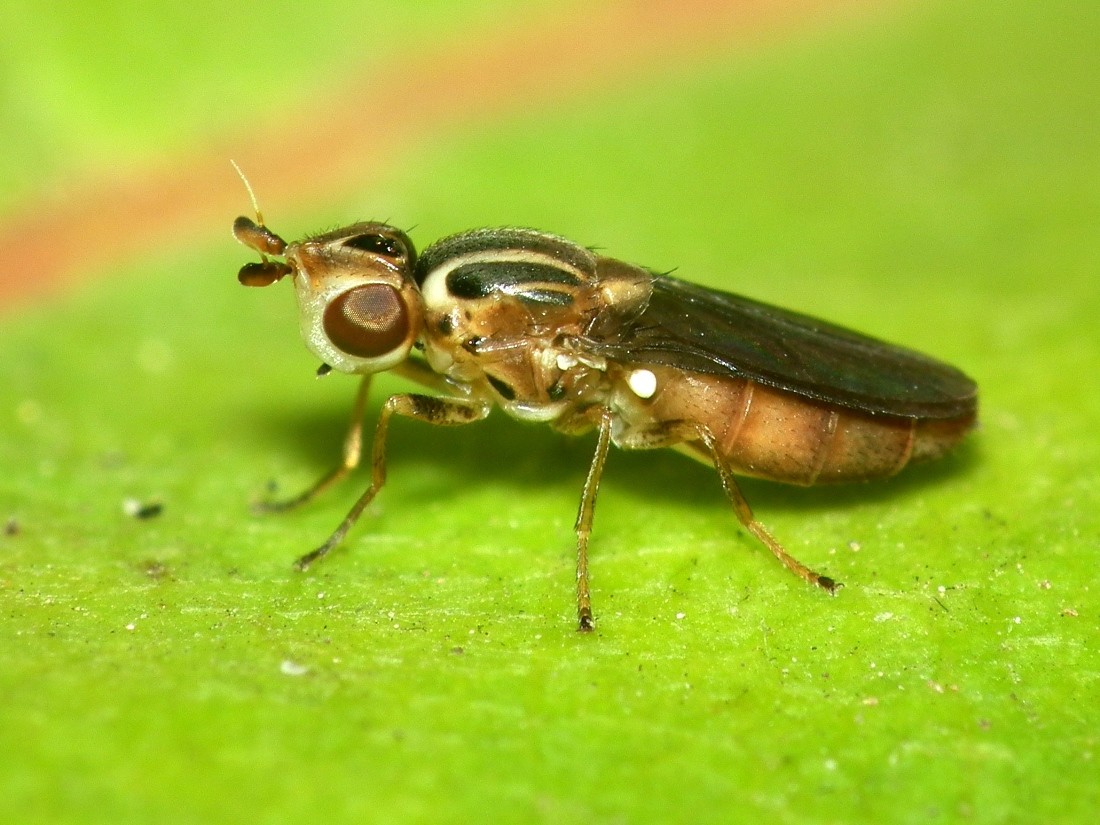
Parectecephala longicornis
Rui Andrade
#1 Print Post
Posted on 17-11-2022 01:01
User Avatar

Member

Location: Portugal
Posts: 3123
Joined: 19.06.07

Hi,

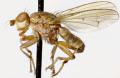
I post this photo at the request of Michael von Tschirnhaus.

location: Esposende (Portugal)
date: 10/10/2017
Rui Andrade attached the following image:

[202.06Kb]
Edited by Rui Andrade on 20-11-2022 23:53
 
www.flickr.com/photos/rui_andrade/
von Tschirnhaus
#2 Print Post
Posted on 18-11-2022 17:51
Member

Location: Bielefeld, Germany
Posts: 454
Joined: 04.11.07

Chloropidae, Chloropinae: Parectecephala longicornis (Fallén, 1820). Along the sandy and dune covered European coasts and comparable inland biotopes this species is not rare. I suspect that the larvae develop in the stolons or roots of Carex arenaria (Cyperaceae) as I caught it by sweeping above this sedge. This robust species seems to be easily identified with its white arista, elongate third antennal segment, protruding frons and the deep velvety black spot on the anterior end of the inner lateral stripe on the scutum (the spot is less distinct in alcohol preserved material). Different from other Chloropinae with a white arista, this species and its congeners are not ovoviviparous (my own studies). But on the Iberian Peninsula and in the Provence, Southern France (my own collecting of 3 females, 1.iv.1980, Pelissane), a very similar species occurs which was also included in Parectecephala by Becker 1910 in his Palaearctic synopsis under the preoccupied name „P. longicornis (Zetterstedt, 1848)“, namely Lagaroceras andalusiacum (Strobl, 1899). From Iran (16.vii.2009, Jahrom/Fars province, 28.534585°N 53,546905°E) I possess a further undescribed sibling species. Here are some differences between L. andalusiacum and P. longicornis: First species: Scutum much more densely haired; no oblique furrow on occiput running towards the base of vti and vte setae; anepisternum bare; no velvety black spot on the lateral stripe of scutum; head not appearing „swollen“; the tiny single propleural seta above fore coxa is present (longicornis: absent); anepisternum, upper half of katepisternum and whole meron (= hypopleuron) completely shiny; sternites not divided by a central, less sclerotized, line; a distinctly smaller species. L. andalusiacum may be the senior synonym of L. nigrum Yang & Yang, 1995 from China. L. andalusiacum is an ovoviviparous species. This is a first still unpublished record for ovoviviparity in the genus Lagaroceras, detected by me in the mentioned Pelissane specimens: One single large larva, still inside its egg shell, filled the whole abdomen of its mother. Searching the keyword „viviparity“, 17 titles on ovoviviparity in Chloropidae are available in my forthcoming database „World Chloropidae online“.
 
http://www.uni-bielefeld.de/biologie/sammlung/inde
Jump to Forum:
Similar Threads
Thread Forum Replies Last Post
Dolichopodidae ID => Dolichopus longicornis Diptera (adults) 3 10-03-2025 14:02
Hybotidae ID -> Platypalpus cf. longicornis Diptera (adults) 4 17-10-2024 19:18
Stratiomyidae: Stratiomys longicornis? Diptera (adults) 3 01-11-2023 17:20
Family, please ... --> Dioctria longicornis Diptera (adults) 4 28-06-2023 16:15
Stratiomys longicornis Larva ID by antylotus. Diptera (eggs, larvae, pupae) 4 18-12-2022 15:58
Date and time
20 February 2026 02:30
Login
Username

Password


Not a member yet?
Click here to register.

Forgotten your password?
Request a new one here.
Temporary email?
Due to fact this site has functionality making use of your email address, any registration using a temporary email address will be rejected.

Paul
Donate
Please, help to make
Diptera.info
possible and enable
further improvements!
Latest Articles
Syrph the Net
Those who want to have access to the Syrph the Net database need to sign the
License Agreement -
Click to Download


Public files of Syrph the Net can be downloaded HERE

Last updated: 25.08.2011
Shoutbox
You must login to post a message.

18.02.26 09:33
Anyone have scans of the Genus Semaranga in: 1)Kanmiya, K. (1983) A systematic study of the Japanese Chloropidae (Diptera). 2) Andersson, H. (1977 Taxonomic and Phylogenetic studies on Chloropid

10.02.26 19:36
Hello Moumoule !

07.01.26 15:52
Pipunculidae from Mongolia! I am looking for specialist who is committed to ID these. There will be a lot of material coming from my expeditions.

06.12.25 21:37
He last posted here in April, identifying some Chloropidae.

04.12.25 20:02
Dr Michael von Tschirnhaus, a leading expert on Chloropidae and Agromyzidae, died on 16 September 2025 at the age of 86. He will be greatly missed by the international community. R.I.P.

03.12.25 12:46
Anyone has the scan of "Harkness, R. D.; Ismay, J. W. 1976: A new species of Trachysiphonella (Dipt., Chloropidae) from Greece, associated with an ant Cataglyphis bicolor (F.) (Hym., Formicidae)

01.12.25 22:29
I will try to fix the messages this month. We have to make some other configuration changes before software goes out of support at end of year.

29.11.25 21:57
I would prefer not to receive any more messages from diptera.info signed by Paul... (Thread reply notification)... Could they be signed by ‘The diptera.info team’?

19.11.25 12:31
It is with deepest sadness in my heart that I announce that on Saturday, November 15, one of the great minds of world dipterology, prof. Rudolf Rozkošny, left us forever. Please remember him with a

15.08.25 10:15
For those specialists not active on Facebook, I just ask to consider to join our group on FB. Please, be aware that it is not necessary at all to be active on FB outside the diptera group. Actually, n

Render time: 0.30 seconds | 260,645,493 unique visits