

Diptera.info :: Identification queries :: Diptera (adults)
 Calliphora vomitoria? (01.08.18) --> Onesia austriaca
|
|
| Juergen Peters |
Posted on 02-08-2018 14:11
|
 Member Location: northwest Germany Posts: 14520 Joined: 11.09.04 |
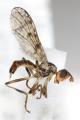
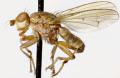
Hello, is this female Calliphora vomitoria. It measured only ~7 mm. On Heracleum at a forest path (northwest Germany). Juergen Peters attached the following image: 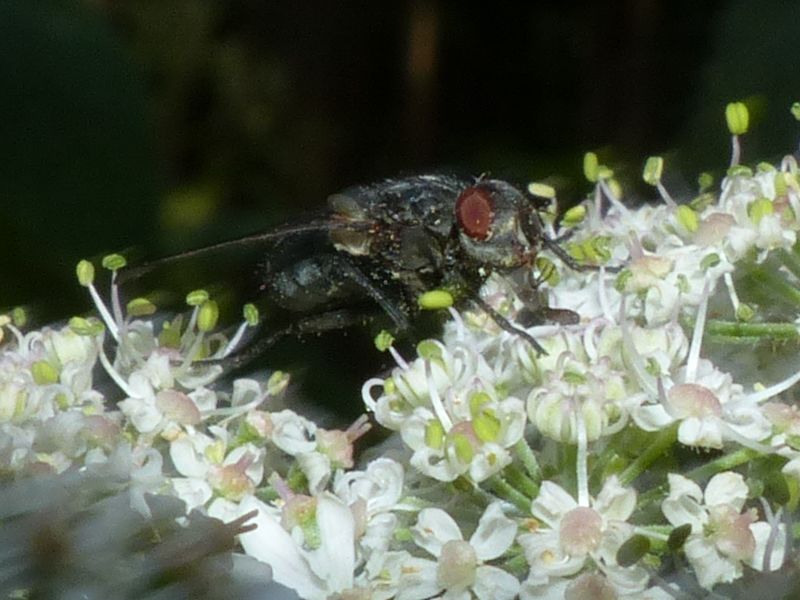 [69.73Kb] Edited by Juergen Peters on 02-08-2018 17:18 Best regards, Jürgen -=-=-=-=-=-=-=-=-=-=-=-=-=-=-=-= Juergen Peters Borgholzhausen, Germany WWW: http://insektenfo... -=-=-=-=-=-=-=-=-=-=-=-=-=-=-=-= |
 |
|
| Juergen Peters |
Posted on 02-08-2018 14:11
|
|
Member Location: northwest Germany Posts: 14520 Joined: 11.09.04 |
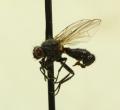
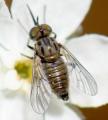
Pic #2
Juergen Peters attached the following image: 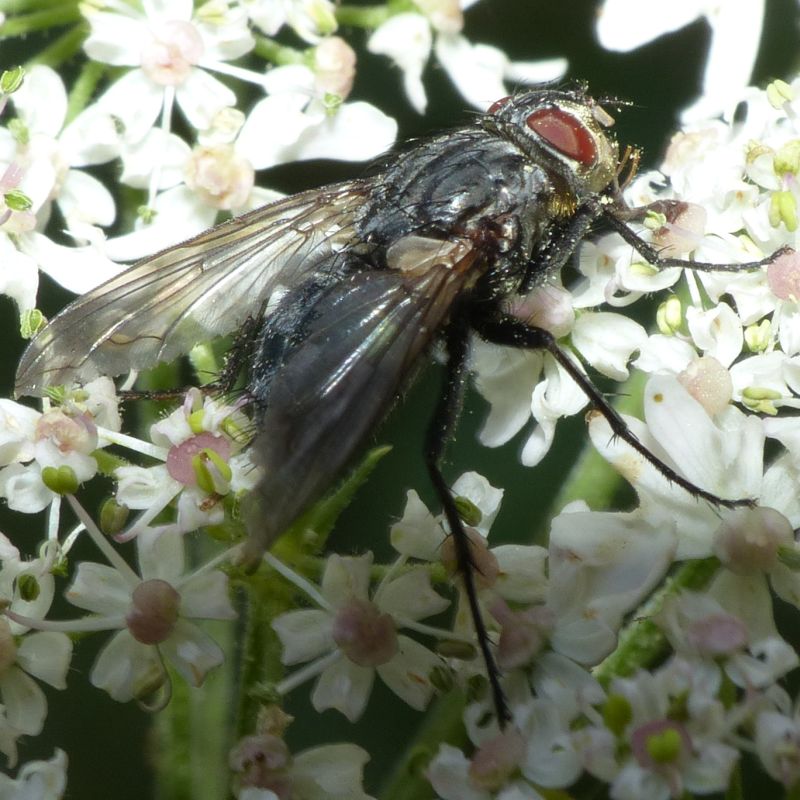 [101.26Kb] Best regards, Jürgen -=-=-=-=-=-=-=-=-=-=-=-=-=-=-=-= Juergen Peters Borgholzhausen, Germany WWW: http://insektenfo... -=-=-=-=-=-=-=-=-=-=-=-=-=-=-=-= |
|
|
|
| johnes81 |
Posted on 02-08-2018 16:48
|
 Member Location: Berlin, Germany Posts: 1980 Joined: 15.10.16 |
bend of the median vein, dark anterior spiracle and thin palpi indicate an Onesia species. I don't see a presutural ia, so i think that Onesia austriaca is the best candidate for this female. And, yes, Onesia have golden yellow hairs on the back of the head. Best wishes, John John and Nini. Naturalists not experts. |
|
|
|
| Juergen Peters |
Posted on 02-08-2018 17:17
|
|
Member Location: northwest Germany Posts: 14520 Joined: 11.09.04 |
Thanks a lot! I only had Onesia floralis three years ago. That genus does not seem to be abundant here.
Best regards, Jürgen -=-=-=-=-=-=-=-=-=-=-=-=-=-=-=-= Juergen Peters Borgholzhausen, Germany WWW: http://insektenfo... -=-=-=-=-=-=-=-=-=-=-=-=-=-=-=-= |
|
|
|
| johnes81 |
Posted on 02-08-2018 17:56
|
|
Member Location: Berlin, Germany Posts: 1980 Joined: 15.10.16 |
Hello Jürgen, Onesia are very abundant in Germany but they are usually undetected. If you can find an area where adults emerge, then you can find many of them feeding on nectar with many different types of diptera. You can find them through November. Keep your eyes open for more. Sometimes it is easy to overlook them on flowers if you are focused on something else. For example, i was photographing a Tachina fera last year when i noticed a male Onesia austriaca sitting right beside it. They are a bit shy and move very quickly. I think that they often scatter as one approaches the flower, so they go unnoticed. one last note: i have a very dark specimen which confused me and even confused Dr. Rognes. After a bit of research, I discovered that the original description mentions that they are black. I can confirm that they are sometimes very dark. My personal key to separate them from Calliphora is the bend of the median vein, the thin palpi (Calliphora palpi are thicker and more of an orange color) and the dark anterior spiracle. The abdomen can be blue or green or dark blue mixed with silver and black tessellations. Best wishes, John John and Nini. Naturalists not experts. |
|
|
|
| Juergen Peters |
Posted on 03-08-2018 21:28
|
|
Member Location: northwest Germany Posts: 14520 Joined: 11.09.04 |
Many thanks for your explanations, John!  I don't think that that I could have overlooked them (at least not all of them). I have been watching insects for over 25 years now (photographing them for 16 years, since 2002) and are meanwhile rather careful not to overlook some when exploring flowers or other "concentration points". Only animals of 2 mm length or below I sometimes miss, finding them on a photo later at home and am resentful of not having paid attention enough to get better pictures of them. And there are *many* 1-2 mm insects on a Heracleum flower... 
Best regards, Jürgen -=-=-=-=-=-=-=-=-=-=-=-=-=-=-=-= Juergen Peters Borgholzhausen, Germany WWW: http://insektenfo... -=-=-=-=-=-=-=-=-=-=-=-=-=-=-=-= |
|
|
|
| johnes81 |
Posted on 03-08-2018 22:23
|
|
Member Location: Berlin, Germany Posts: 1980 Joined: 15.10.16 |
Hello Jürgen, you do a great job of documening the nature around you. You find many insects and spiders and i can confirm that it isn't easy getting shots (or photos) of them at times. You do well, my friend lately i am not sleeping well and the weather is very hot (as you know). My arm is hurting for some reason. Anyway, i hate typing. I've always hated typing on a keyboard. Sometimes i post incomplete thoughts. I just noticed my sloppy post here, so i want to take a moment to correct some data: i meant to explain that the lack of a presutural ia indicates O. floralis. However, the fly in your photo is very damaged and many bristles are missing. I cannot key it properly with such damage. But i have learned alot about Onesia the past two years. I remember the strikingly obvious golden yellow hairs on the back of the head the very first time that i examined O. austriaca under the microscope. In fact, i told my wife verbatim "i am worried that i will misidentify O. austriaca as Calliphora vomitoria in a photo". The amount of golden yellow hairs seems to be much greater than that of O. floralis. I have not tested enough specimens to deem this as reliable but so far all of my specimens with such an amount of obvious golden yellow hairs have turned out to be O. austriaca. The very dark form had less golden yellow hairs but this may be due to maturity. I will keep testing this with O. floralis. I believe you when you say that Onesia are not abundant in your area. I know that you cover nature well where you live. I hope that you have a pleasant night, John John and Nini. Naturalists not experts. |
|
|
|
| Jump to Forum: |