

Diptera.info :: Identification queries :: Diptera (adults)
 Acalyptrate to ID
|
|
| Rui Andrade |
Posted on 03-10-2010 23:37
|
 Member Location: Portugal Posts: 3123 Joined: 19.06.07 |
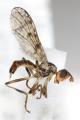
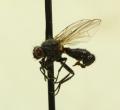
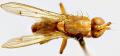
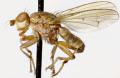
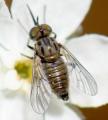
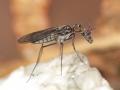
My brother found a strange mass of twigs and garbage hanging from a dead branch over a stream that was completely full of flies from this species you can see below. What can be said about it? location: Silves, Portugal date: 02/10/2010 YouTube Video Rui Andrade attached the following image:  [54.65Kb] |
 |
|
| Rui Andrade |
Posted on 03-10-2010 23:38
|
|
Member Location: Portugal Posts: 3123 Joined: 19.06.07 |
.
Rui Andrade attached the following image:  [60.95Kb] |
|
|
|
| Rui Andrade |
Posted on 03-10-2010 23:39
|
|
Member Location: Portugal Posts: 3123 Joined: 19.06.07 |
.
Rui Andrade attached the following image:  [91.13Kb] |
|
|
|
| Rui Andrade |
Posted on 03-10-2010 23:40
|
|
Member Location: Portugal Posts: 3123 Joined: 19.06.07 |
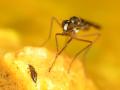
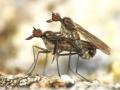
In this photo you can see many specimens resting on the shadow.
Rui Andrade attached the following image:  [73.74Kb] |
|
|
|
| Rui Andrade |
Posted on 03-10-2010 23:41
|
|
Member Location: Portugal Posts: 3123 Joined: 19.06.07 |
.
Rui Andrade attached the following image:  [185.32Kb] |
|
|
|
| Andrzej |
Posted on 04-10-2010 00:08
|
|
Member Location: Poland Posts: 2443 Joined: 05.01.06 |
Probably a Piophilid fly !
Dr. A. J. Woznica, Institute of Biology, Wroclaw University of Environmental & Life Sciences. Poland |
|
|
|
| Nosferatumyia |
Posted on 04-10-2010 07:11
|
 Member Location: Posts: 3583 Joined: 28.12.07 |
certainly a piophilid
Val |
|
|
|
| Rui Andrade |
Posted on 05-10-2010 00:43
|
|
Member Location: Portugal Posts: 3123 Joined: 19.06.07 |
Thank you so much Andrzej and Valery! Any idea to what genus it belongs to? |
|
|
|
| jorgemotalmeida |
Posted on 05-10-2010 11:12
|
 Member Location: Viseu - PORTUGAL Posts: 9296 Joined: 05.06.06 |
Hmm... Andrey Ozerov tolds me that this is not a piophilid.
Edited by jorgemotalmeida on 05-10-2010 11:16 |
|
|
|
| Paul Beuk |
Posted on 05-10-2010 12:18
|
 Super Administrator Location: Netherlands Posts: 19403 Joined: 11.05.04 |
My first impression was Anthomyzidae but when so many people seemed to be convinced it was Piophilidae I decided to shut up...
Paul - - - - Paul Beuk on https://diptera.info |
|
|
|
| Rui Andrade |
Posted on 05-10-2010 17:54
|
|
Member Location: Portugal Posts: 3123 Joined: 19.06.07 |
What a confuse fly . If an anthomyzid, which one? . If an anthomyzid, which one? |
|
|
|
| jorgemotalmeida |
Posted on 06-05-2013 19:20
|
|
Member Location: Viseu - PORTUGAL Posts: 9296 Joined: 05.06.06 |
Chloropidae. |
|
|
|
| Nosferatumyia |
Posted on 06-05-2013 19:35
|
|
Member Location: Posts: 3583 Joined: 28.12.07 |
Chloropid with vibrissae? Something more remarcable than a woman with beard.
Val |
|
|
|
| von Tschirnhaus |
Posted on 06-05-2013 20:00
|
|
Member Location: Bielefeld, Germany Posts: 454 Joined: 04.11.07 |
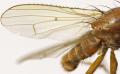
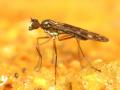
Apotropina longepilosa (Strobl, 1893), Chloropidae, Siphonellopsinae: Only two Apotropina species in Europe, many tropical species especially in the Australasian Region, mostly undescribed. Some species aggregate by thousands in shelters or caves (Namibia, Australia). Few is known on the developmental stages. Diverse biology of this plesiomorphic subfamily. Some long orbital bristles reclinate some proclinate, one or two proclinate intercalar bristles [to be seen in the photograph] inwards of the shoulders and many other pecularities within the chloropid family, for example the highly asymmetric male postabdomen. M. von Tschirnhaus thoroughly studied six of the Portuguese specimens and compared them with his material of the European species, A. longepilosa and A. brevivenosa Dely-Draskovits, 1977, from Germany, France and Turkey. There is certain variability in A. longepilosa concerning the pubescence of the pleuron. Partly the mesopleuron (= anepisternum) is shining but completely covered with some dust, partly the black mark on the lower side of the mesopleuron is shiny, the other part distinctly matt. The propleuron is not completely shining, but its lower hind corner is dusted, too. Distinctions between the length of the arista does not work well, though the arista of longepilosa is a bit shorter. The length of the criss-crossed acr in comparison to the orbitals does not work at all. I confirmed only some of Dely-Draskovits’ distinguishing characters and detected furthers: The wings are brownish in longepilosa. In brevivenosa the dark veins are much darker than the hyaline membrane. Epandrium small in A.l. and big and more rounded in A.b. Whitish pubescence of 3rd antennal segment very dense and longer in A.l., normal and scarcer A.b. Peristome with dark narrow edge in A.l., yellow in A.b. Lower part of face brownish or slightly darkened in A.l., yellow in A.b. 2nd costal section much longer than 3rd in A.l., short in A.b. 3rd antennal segment sexualdimorphic (females blackish), males: lower part ochrous or brownish in A.l., yellow in A.b. 3+1 or mostly 3+2 dc in A.l., 3rd dc from behind not shorter than 4th, all becoming shorter towards the head; A.b: 3+1 dc, the 3rd shorter than the 2nd and the 4th. Edited by von Tschirnhaus on 31-05-2013 15:58 |
|
|
|
| Rui Andrade |
Posted on 06-05-2013 20:52
|
|
Member Location: Portugal Posts: 3123 Joined: 19.06.07 |
Thank you for your help! I had already sent some specimens to Jindrich Rohacek and he reached the same conclusion as you.  |
|
|
|
| Jump to Forum: |